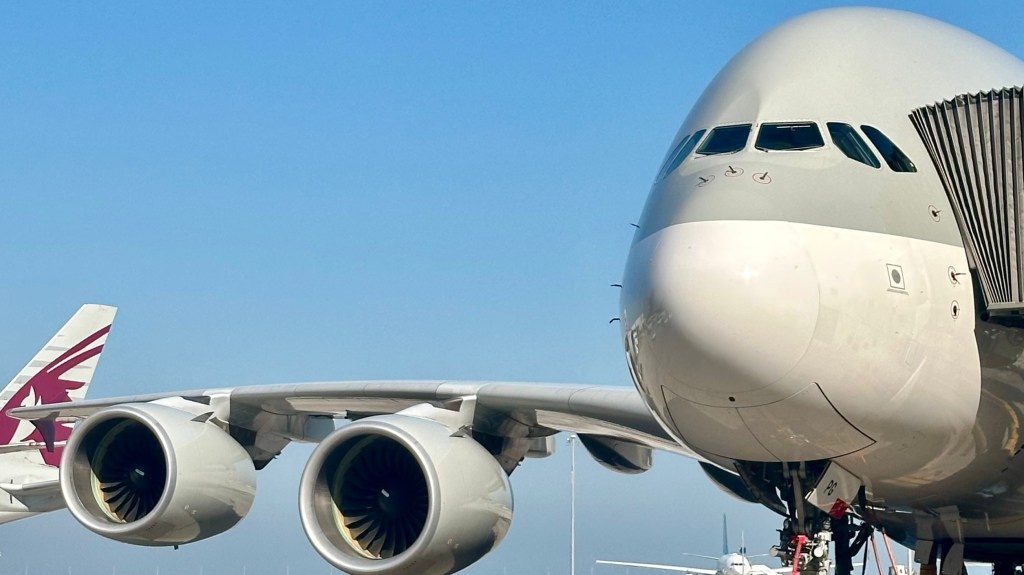
Five airports around the world dominate the “superconnector” conversation: Dubai, Doha, Istanbul, Abu Dhabi, and Riyadh. These are airports which exist to connect traffic flows across continents — Asia to Europe, Africa to North America — and have built their models on precision, frequency, and the ability to move millions of people with minimal friction. Each has pursued a different path to scale. Yet only one, Doha, has increased the proportion of connecting passengers year after year, even as total traffic has grown.
Doha’s Hamad international Airport is now leading the world with the highest share of all connecting traffic. Seventy-four percent of all passengers transiting through Hamad International Airport are in transfer, up from 66 percent in 2015, per OAG.
Over in Dubai, connecting traffic has declined from 50 percent to 47 percent. That change reflects a wider shift in the airport’s growth model. Dubai has seen significant gains in point-to-point traffic, particularly on high-frequency routes across Asia and Europe. Its home carrier, Emirates, has built scale in both transfer and destination markets, but the city’s wider appeal — shopping, business, tourism — has increasingly tilted the balance toward inbound demand. Dubai’s origin-and-destination market is among the strongest in the region, and the airport benefits from high volumes of traffic that start or end in the city. As a result, its reliance on connecting passengers has gradually diminished.
Abu Dhabi has moved in a different direction. Once heavily reliant on connecting traffic via Etihad Airways, it has since shifted strategy. Etihad has cut unprofitable routes, exited certain long-haul markets, and focused more on sustainable yield than aggressive expansion. At the same time, Abu Dhabi has invested in tourism and destination infrastructure. Yas Island, Saadiyat developments, and growing MICE traffic have repositioned Abu Dhabi to attract more inbound travellers. The result: connecting traffic has dropped more sharply than in Dubai, down from 67 percent to 51 percent.
In Istanbul, which has grown rapidly in total volume and now hosts Turkish Airlines’ expansive global network, has only seen a modest increase in transfer share — from 53 percent to 59 percent.
Riyadh, by contrast, is still in the early stages of building its hub model. Just 18 percent of passengers connect there, up slightly from 17 percent. For now, it functions more as a point-to-point gateway, with major expansion still several years away.
Doha leading the field in percentage of connecting flows demonstrates that Hamad International has not only grown in scale but matured as a pure transit hub. It has executed a model that is focused, integrated, and deliberately structured around connectivity.
As many would expect, Qatar Airways operates over 80 percent of the airport’s capacity. This enables tightly coordinated scheduling, well-structured connection banks, and minimum connection times that are among the shortest in the world. It is a model where airline and airport are fully aligned. At the same time, nearly 60 other carriers now serve Hamad International Airport — including Japan Airlines, Malaysia Airlines, and Xiamen Air — and their presence has added further momentum to connecting traffic. Much of this is driven by commercial partnerships, such as codeshares and interline agreements with Qatar Airways, which allow for seamless onward travel across a wider network.
This has allowed Doha to steadily grow its share of long-haul connecting markets. On the key Asia–Europe corridor, it has increased its market share from 7.8 percent in 2015 to 12.3 percent in 2025. That is a larger gain than either Istanbul or Abu Dhabi. It has come at a time when Indian and Chinese hubs remain constrained, and demand has rebounded more strongly in emerging markets than in mature ones.
Still, it would be a mistake to see Doha only as a transit point. Since the 2022 FIFA World Cup, Qatar has invested heavily in positioning Doha as a destination. That strategy is working. In 2023, the city recorded more international visitors than it did during the World Cup year. In 2024, it built on that growth, with over four million inbound travellers. This was not driven by one-off events, but by sustained interest in Doha’s cultural, business, and leisure offering.
This pivot toward point-to-point demand is deliberate. By increasing its attractiveness as a final destination, Doha reduces its reliance on transfer traffic alone. It also creates new dynamics for airline scheduling and hotel development. Even small shifts in the percentage of connecting passengers who opt for multi-day stopovers can have significant downstream economic effects. For now, Doha remains primarily a connecting hub. But that balance is evolving.
Riyadh’s new airport, King Salman International, is under construction and hopes to eventually handle between 120 and 185 million passengers per year. Turkish Airlines is scaling toward 200 million passengers at Istanbul Airport by 2028. Dubai is in the process of shifting its growth to DWC. Doha’s next phase of airport expansion remains further out, and that may create capacity pressure sooner than expected.
The current terminal at HIA will begin to feel pressure as passenger numbers approach the high 70-million range. A second terminal will be necessary to stay competitive, especially against Riyadh, which is starting from scratch and building for scale.
Equally, Doha must navigate a more contested landscape. Indian carriers are growing. Chinese traffic is returning. European airports are lobbying for more slots and liberalised bilaterals. Gulf competition is no longer just between Emirates and Qatar Airways. It now includes the rise of Saudia Arabia, and ambitions from secondary airports in the region.
However, Doha’s value proposition remains strong. It connects markets that are not always well linked. It offers frequency, convenience, and speed. And in a fragmented global airspace, it provides one of the cleanest examples of a tightly integrated hub system.The idea of the super connector is not static. It will evolve over the next decade, shaped by geopolitics, fleet decisions, infrastructure timelines, and shifts in global demand. Some hubs will lose relevance. Others will overextend. The challenge for Doha is not to outgrow itself, but to maintain what has worked while building for the next phase of demand.


 Aviation Analyst
Leave a comment